Quality & process
Quality you can check, not just trust.
Every product starts as a crop we can name, is cleaned before anything else happens, is made the way that suits it, and leaves in a sealed pack with a batch number. Here is what happens between the field and your kitchen.
The process
Five steps between the field and the pack.
Choose the crop
From Gujarat's growers and our families' own fields — seen, sampled and checked for moisture before it is bought.
Clean & sort
Destoning, sieving and sorting take out stones, stalks, dust, husk and damaged grain.
Make
Shade-drying, dehydration, roasting, milling or pressing — the method that suits each product (see below).
Test
Each batch is sampled; tests at NABL-accredited laboratories cover what matters for that product and market.
Pack & label
Sealed food-grade packs with batch number, best-before date and full FSSAI labelling. A retained sample is kept.
How each product is made
Each product, its own method.
A leaf powder, a roasted peanut and a pressed oil need very different handling. These are the rules we hold each one to.
Leaf powders
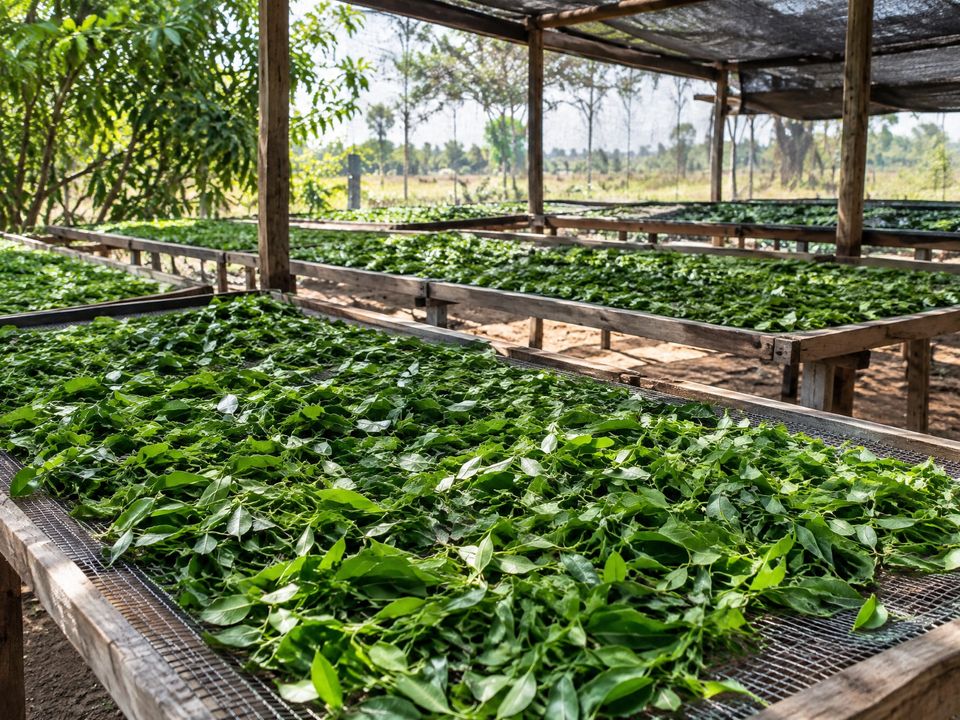
Moringa and curry leaves are dried in the shade, out of direct sun, so they keep their green colour and aroma, then milled and sieved to an even mesh.
Vegetable & fruit powders
Onion, garlic, beetroot, tomato, ginger and raw mango are washed, cut and dried at controlled temperature until they are dry enough to keep, then milled.
Spices & masalas
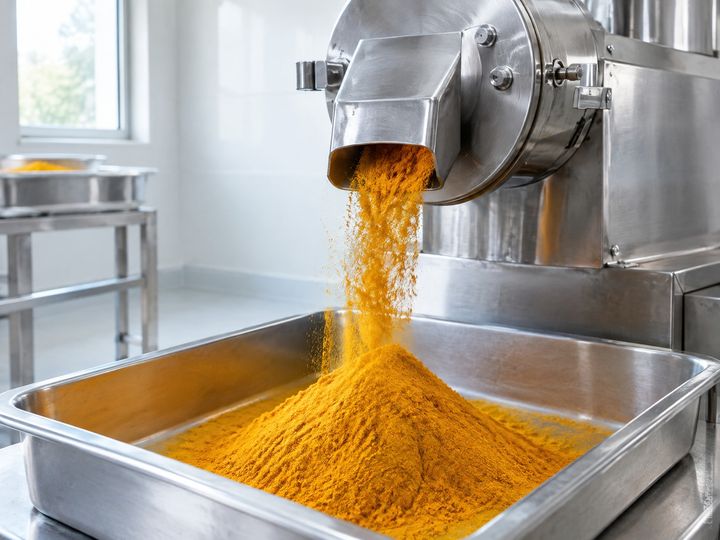
Whole spices are cleaned and sorted, ground in small batches so they don't overheat, and blended to a fixed recipe for each masala.
Peanuts & chikki
Kernels are hand-picked, roasted slowly, cooled and packed straight away; chikki is set in jaggery and sealed against humidity.
Oils
Groundnut and sesame are pressed and filtered — no chemical refining, bleaching or deodorising — and filled into sealed bottles and tins.
Flours, millets & dals
Grain is cleaned and destoned before milling; bulk flour is milled to order. Dals are cleaned and sorted, never polished with oil or colour.
Testing
What we test, and why it matters.
Not every batch needs every test. These are the tests that matter for each kind of product. Export lots always ship with a certificate of analysis, and bulk buyers can ask for the report on any batch.
| Test | Why it matters | Usually needed for |
|---|---|---|
| Moisture | Too much moisture invites mould and clumping; too little can mean over-drying. | Every product |
| Microbiology (e.g. Salmonella, E. coli) | Required for ready-to-eat powders, masalas and chutneys. | Powders, masalas, chutneys, exports |
| Aflatoxin | A mould toxin with tight limits in food. | Groundnut, peanut products, chilli, maize, dry fruits |
| Added colour & lead chromate | Turmeric and chilli are common targets for adulteration; tests catch it. | Turmeric, chilli, masalas |
| Pesticide residues | Must meet the maximum residue limits of India and of the importing country. | Export lots, especially EU and UK |
| Ethylene oxide | Banned as a fumigant in the EU; spices are routinely tested for it. | Spices for the EU, UK and other strict markets |
| Heavy metals | Lead, cadmium and arsenic limits apply in most markets. | Powders, turmeric, export lots |
| Acid value & purity | Shows the oil is fresh and not mixed with other oils. | Groundnut and sesame oil |
| Purity & volatile oil | How clean the seed is, and how much aroma it carries. | Cumin, fennel, coriander, ajwain |
Our rules
Five things we won't do.
- Add artificial colour, fillers or flavour enhancers.
- Polish dals or refine oils with chemicals.
- Fumigate with ethylene oxide.
- Call anything organic without a valid certificate.
- Make medical or health claims about food.
Have a specification? We'll quote against it.
Send the products and pack sizes, or the quantity and your city or port. We reply within one working day — Monday to Saturday, 9 AM – 7 PM IST (UTC+5:30).